Security Enablement
Enterprise Database Encryption Demonstration & Security Enablement
Designing and delivering a controlled live database encryption demonstration that made enterprise data-protection architecture understandable without exposing sensitive customer information.
Role
Product Engineer
Duration
Entrust APAC Partner Bootcamp 2026
Author
Jason Sariwating
Executive Summary
This case study covers the design and delivery of a live enterprise database encryption demonstration during the Entrust APAC Partner Bootcamp 2026 in Bali. I represented PT. i-Trust Data Teknologi, shared a generalized customer-success context, and demonstrated how database protection can be explained through a practical technical workflow.
The objective was not only to show that encryption could be enabled. The demonstration needed to connect four ideas clearly:
- Why sensitive database information requires stronger protection.
- Where encryption and key protection fit within an enterprise architecture.
- How authorized applications continue to use protected data.
- How technical evidence can be presented without disclosing customer-specific information.
The work combined solution understanding, environment preparation, validation, troubleshooting, technical storytelling, and live presentation. It also required balancing technical depth with an audience that included partners from different organizations and backgrounds.
Context
Database encryption is easy to describe at a high level but harder to demonstrate well. The most important controls are often invisible to the audience: key access, cryptographic policy, protected key storage, authorization, and the distinction between application-level access and raw database exposure.
A useful demonstration must therefore show more than a successful command or a changed configuration. It should explain what risk is being reduced, where the protection is applied, what remains unchanged for authorized users, and how the result can be validated.
For the APAC Partner Bootcamp, the demonstration also needed to support a broader customer-success narrative. The technical flow had to be understandable to people who did not share the same environment, while remaining accurate enough for engineers and security practitioners.
Problem
The central challenge was to make an enterprise database protection workflow visible, credible, and safe to present.
Several constraints shaped the work:
- Database encryption involves multiple layers rather than one isolated feature.
- Key protection and cryptographic policy are difficult to observe directly.
- A live demonstration must remain repeatable under time and presentation pressure.
- Real customer data and infrastructure details cannot be used as presentation material.
- The audience needs a clear connection between technical controls and business value.
- The demonstration must avoid implying that encryption alone solves every data-security problem.
Without a structured narrative, the audience could see a configuration change without understanding the security boundary. With too much implementation detail, the main message could be lost or sensitive information could be exposed.
Objectives
The demonstration was designed around the following objectives:
- Present a clear before-and-after data-protection scenario.
- Explain the relationship between the application, database, encryption layer, cryptographic service, and protected key boundary.
- Use representative data instead of production or customer information.
- Validate that protected data behaved as expected for both authorized application access and lower-level inspection.
- Keep the workflow repeatable enough for rehearsal and live delivery.
- Translate the technical result into operational and business relevance.
- Prepare a recovery path if one demonstration step did not behave as expected.
Scope and Safety Boundaries
The case study focuses on technical enablement rather than a full production deployment or compliance assessment.
| Included | Intentionally Excluded |
|---|---|
| Generalized database encryption architecture. | Customer names and production records. |
| Representative application and database workflow. | Real credentials, endpoints, and network topology. |
| High-level key-protection relationship. | Key identifiers, policy values, and administrative procedures. |
| Functional validation and presentation evidence. | Product licensing, internal commercial information, and proprietary configuration. |
| Security and operational considerations. | Claims of formal compliance certification or audit conclusions. |
This boundary made the demonstration useful as technical evidence while keeping the content appropriate for a public portfolio.
High-Level Architecture
The demonstration architecture was presented as a series of responsibilities rather than a product-specific topology.
Application & Database
Uses representative data through the normal application workflow.
Protection Integration
Applies the configured data-protection policy at the integration boundary.
Cryptographic Service
Coordinates approved encryption operations and policy enforcement.
Protected Key Boundary
Keeps cryptographic keys under controlled hardware-backed protection.
Validation & Evidence
Confirms protected storage, authorized access, and repeatable results.
At a high level, the application continues to interact with the database through its expected workflow. A protection integration layer applies the configured data-protection behavior. Cryptographic operations use controlled key services, while protected key material remains under the appropriate security boundary.
Validation then checks two perspectives:
- Authorized use: the application can continue its intended business operation.
- Protected storage: lower-level data exposure does not reveal the same sensitive value in its original readable form.
The exact architecture varies between environments. The important design principle is to separate application authorization, data protection, key management, and operational validation into clear responsibilities.
Demonstration Workflow
The live sequence was organized into six stages so the audience could follow both the technical change and its purpose.
Define
Set the learning objective, audience, and safe demonstration boundary.
Prepare
Create representative sample data and a repeatable environment.
Baseline
Show the expected application and database behavior before protection.
Protect
Apply the configured encryption and key-protection workflow.
Validate
Verify protected storage and authorized application access.
Explain
Connect the technical result to security and business value.
1. Define the Learning Outcome
Before preparing the environment, I identified what the audience should understand at the end of the session. The core message was that enterprise database encryption is a system design involving data flow, policy, key protection, and authorized access, not simply a checkbox applied to a database.
This prevented the presentation from becoming a collection of disconnected configuration screens.
2. Prepare Representative Data
The demonstration used controlled sample information that could safely show changes in data state. The records needed to be recognizable enough for the audience to compare, but they could not contain real personal, customer, or operational data.
Representative data also made rehearsal repeatable. The same baseline could be restored and tested without depending on a production dataset.
3. Establish a Baseline
The initial workflow showed the application's expected behavior and the database state before protection was applied. This gave the audience a reference point and confirmed that the demonstration environment was functioning normally.
The baseline answered three questions:
- Can the application create and retrieve the sample record?
- Is the expected value visible through the authorized application flow?
- What does the relevant stored representation look like before protection?
4. Apply the Protection Workflow
The next stage introduced the configured database encryption and key-protection relationship. The explanation focused on responsibilities and data flow instead of revealing implementation secrets.
The important points were:
- Protection is applied through a controlled policy or integration boundary.
- Cryptographic keys are managed separately from ordinary application data.
- Authorized applications still require appropriate identity and access controls.
- The protection workflow must be validated after configuration changes.
5. Validate the Result
Validation compared the authorized application experience with the protected database representation. A successful result needed to show that the business workflow remained usable while the selected data was no longer exposed in the same readable form at the lower layer.
The demonstration also emphasized that successful encryption does not replace authorization, logging, monitoring, backup protection, or secure application design.
6. Explain the Security Value
The final stage translated the technical result into a security narrative. The audience could see why protected key management matters, how data exposure risk can be reduced, and why a production design still requires operational governance.
This translation was essential because technical success alone does not guarantee that stakeholders understand the control or can evaluate where it fits in their environment.
Engineering Approach
Design the Story Before the Screens
I treated the demonstration as a technical product with a user journey. Each step needed a purpose, expected input, visible output, and transition to the next concept.
The sequence was designed to move from familiar application behavior toward less visible security controls. This reduced the amount of explanation required before the audience could see value.
Keep the Environment Repeatable
A live security demonstration should not depend on undocumented manual state. Preparation focused on establishing a known baseline, consistent sample data, expected configuration state, and validation checkpoints.
Repeatability supported both rehearsal and troubleshooting. When a result differed from expectation, the issue could be isolated to a smaller stage instead of restarting the entire presentation without understanding the cause.
Separate Demonstration Configuration from Sensitive Operations
The presentation material used logical descriptions rather than operational secrets. Credentials, endpoints, key references, and environment-specific values were not included in slides, screenshots, or public documentation.
This also reinforced a useful engineering practice: presentation assets and reusable technical documentation should remain safe even when shared beyond the original project team.
Build Validation into Every Stage
Instead of waiting until the final screen, the workflow included checkpoints after baseline preparation, protection configuration, application access, and stored-data inspection.
This made failures easier to explain. It also helped distinguish between an application issue, database issue, protection-policy issue, key-service issue, or presentation-state issue.
Validation Strategy
The validation plan focused on observable outcomes rather than product-specific screens.
| Validation Area | Question | Expected Evidence |
|---|---|---|
| Application baseline | Does the normal workflow function before protection? | Sample data can be created and retrieved through the intended interface. |
| Protection state | Is the selected protection behavior enabled? | The environment reports the expected generalized policy state. |
| Authorized access | Can the application continue its intended operation? | Authorized reads and writes remain functional within the demonstration scope. |
| Stored representation | Is selected information protected at the lower layer? | The original readable value is not exposed in the same form. |
| Key boundary | Are cryptographic operations separated from ordinary data handling? | The architecture and operational flow use controlled key services. |
| Repeatability | Can the sequence be restored and demonstrated again? | Baseline, execution, and validation steps produce consistent outcomes. |
These checks demonstrate functional behavior. They do not constitute a penetration test, compliance audit, or production security certification.
My Contribution
My responsibilities included:
- Understanding the customer-success context and identifying a safe technical narrative.
- Designing the high-level database protection flow for the presentation.
- Preparing representative sample data and a controlled demonstration sequence.
- Configuring and validating the required demonstration environment.
- Testing the baseline and protected behavior before the event.
- Troubleshooting technical issues across application, database, and cryptographic layers.
- Structuring the live explanation for an APAC partner audience.
- Delivering the live database encryption demonstration.
- Collaborating with team members and partners during preparation and the event.
- Keeping sensitive implementation and customer information outside the public presentation.
Technical and Presentation Challenges
| Challenge | Engineering Response |
|---|---|
| Security controls were not directly visible. | Used before-and-after validation and a layered architecture explanation. |
| The audience had different technical backgrounds. | Introduced business context first, then progressively added technical depth. |
| Live demonstrations can fail because of hidden environment state. | Used a known baseline, checkpoints, rehearsal, and a recovery path. |
| Real configurations could expose sensitive information. | Replaced them with generalized labels, representative data, and sanitized evidence. |
| Too much detail could obscure the main message. | Focused each step on one observable result and one security takeaway. |
| Encryption could be misunderstood as complete data security. | Explicitly explained the continued need for access control, monitoring, and secure operations. |
Security and Compliance Context
Database protection requirements are often influenced by data classification, privacy obligations, organizational risk, and security frameworks. Through enterprise security work, I have developed working familiarity with contexts such as Indonesia's Personal Data Protection Law, ISO/IEC 27001, PCI DSS, and related international frameworks.
For this demonstration, that familiarity helped frame useful questions:
- Which information should be treated as sensitive?
- Where can readable data be exposed?
- Who should be authorized to access the protected workflow?
- How are cryptographic keys separated from ordinary application data?
- What evidence would help an organization understand that the control is working?
- How should the implementation be documented and operated?
This is practical requirements awareness used to support solution design and customer discussions. It is not presented as formal audit, legal, or compliance certification expertise.
Live Presentation and Knowledge Sharing
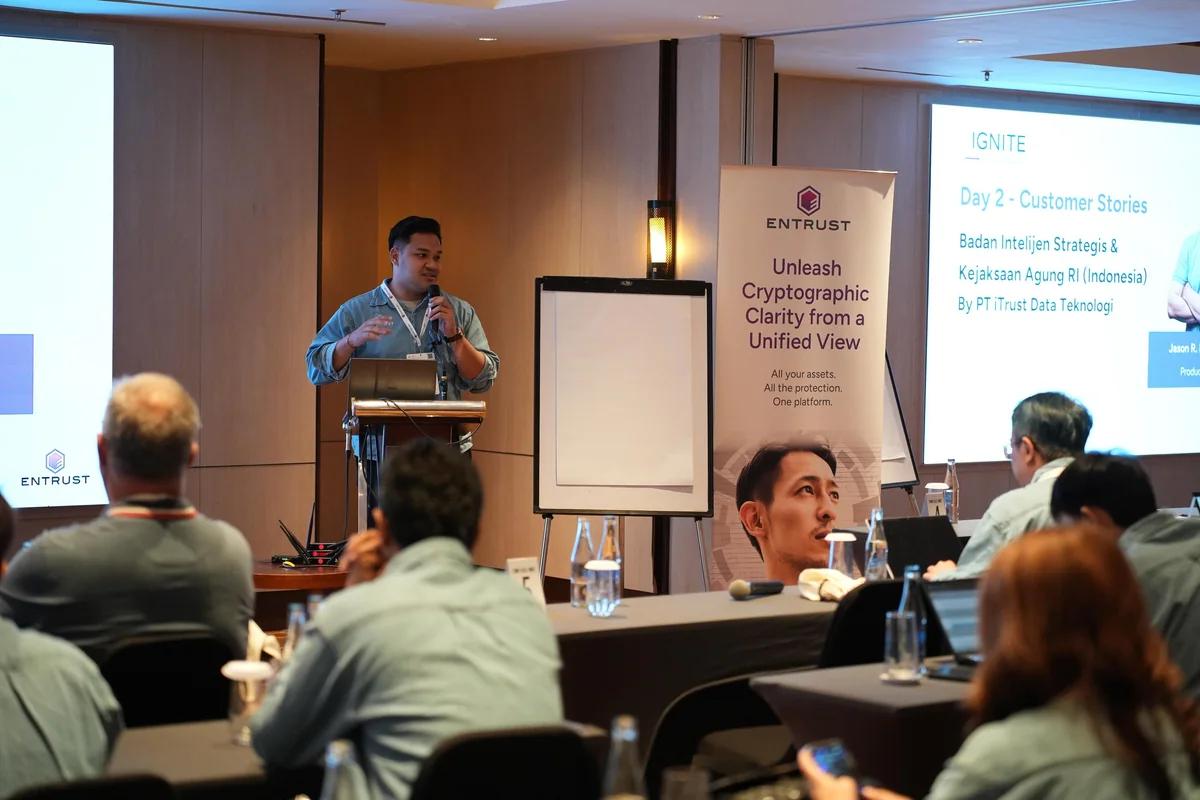
Presenting to partners from across the APAC region changed the nature of the work. The solution had to be technically accurate, visually understandable, and resilient enough for a live event.
The experience strengthened several skills beyond implementation:
- Explaining cryptographic concepts without relying on internal terminology.
- Moving between business risk, architecture, and technical evidence.
- Adapting the level of detail to audience feedback.
- Collaborating with people from different partner organizations.
- Maintaining composure and structure during a live technical demonstration.
Results and Impact
The outcome was qualitative rather than a claim of customer production metrics. The demonstration:
- Presented a complete database protection story from problem to validation.
- Made the relationship between database encryption and protected key management easier to understand.
- Showed a practical customer-success context without exposing customer-sensitive information.
- Created a reusable structure for future technical demonstrations and enablement sessions.
- Supported knowledge sharing among partners from across the APAC region.
- Strengthened my technical communication, presentation, and cross-team collaboration skills.
- Reinforced the value of combining engineering execution with clear solution storytelling.
What I Would Improve Next
For a future iteration, I would extend the demonstration process with:
- Automated environment pre-checks before the presentation starts.
- A scripted baseline reset using only safe demonstration data.
- Separate technical and executive presentation tracks using the same architecture.
- A compact troubleshooting dashboard for dependency and policy state.
- Additional negative-path scenarios showing unauthorized or misconfigured access safely.
- A reusable validation report that records the expected checkpoints without sensitive values.
- Performance observations for controlled test workloads, clearly separated from production benchmarks.
These improvements would make the demonstration easier to repeat, transfer, and operate while preserving the same confidentiality boundaries.
Lessons Learned
A Demonstration Is an Engineered Experience
Technical accuracy is necessary, but it is not enough. A strong demonstration has a defined audience, controlled state, visible evidence, recovery steps, and a clear conclusion.
Validation Should Be Part of the Story
Showing configuration without validating behavior leaves uncertainty. The most useful evidence connects the application experience, protected storage, and key-management boundary.
Security Communication Requires Deliberate Abstraction
Removing sensitive details should not remove the engineering value. A carefully generalized architecture can explain responsibilities, trust boundaries, and validation without publishing operational information.
Product Engineering Connects Technology to Outcomes
This experience reinforced that Product Engineering in enterprise security involves more than configuration. It requires understanding the problem, designing a usable workflow, validating the result, documenting the process, and communicating why it matters.
Confidentiality Boundaries
The following details remain intentionally excluded from this portfolio:
- Customer and end-user identities.
- Production database technology and topology.
- Hostnames, IP addresses, ports, and network routes.
- Usernames, passwords, tokens, and authentication workflows.
- Key labels, identifiers, policy values, and administrative procedures.
- Product-specific commands and proprietary configuration.
- Customer performance data and production operational metrics.
The case study documents the engineering approach and learning outcome rather than reconstructing a customer environment.
Final Takeaway
The Enterprise Database Encryption Demonstration combined data protection, cryptographic architecture, validation, and technical enablement into one coherent experience. Its value came from making an invisible security control understandable while maintaining a strict boundary around customer and operational information.
For me, the project demonstrated an important part of Product Engineering: turning complex enterprise security capabilities into a practical workflow that people can understand, evaluate, and apply to their own requirements.